

August 3 2019: FRENCH, Mary-Hill
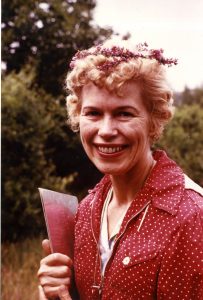
Mary-Hill French, Geologist, 102
Mary-Hill French, a geologist who prepared bomb target maps for the U.S. Army Air Force in World War II, became the first woman professional hired by the iron-mining industry in northern Minnesota, and collaborated for more than half a century in the research and writings of her husband, a NASA geologist and planetary scientist, died on July 26, 2019 in Bethesda, Maryland. She was 102 years old. Her husband, Bevan M. French, said that the cause of death was complications from a pulmonary infection.
Originally intending to become either a lawyer or a journalist (preferably an international reporter) when she arrived at college in 1934, Ms. French instead majored in geology after a freshman course with an exciting and inspiring professor. Needing tuition money, she happily accepted the job of geology lab instructor, and the die was cast. During the eight decades after graduation, she continually and energetically combined a wide range of different activities into a long and active life: graduate study, engineering work for a mining company, marriage, family, travel, and service to a wide range of scientific, educational, and social organizations. Since 1967, she was also a constant colleague, collaborator, and editor in the research, professional travels, publications, and educational activities of her second husband, Bevan M. French, now a retired NASA geologist, planetary scientist, and program administrator.
Mary-Hill French was born Mary-Hill Kueffner, on November 14, 1916 in St. Paul, MN, the daughter of William and Helen Kueffner. She attended local schools, including Summit School in St. Paul, then attended Carleton College in Northfield, MN, receiving a B.A. in 1938 Magna Cum Laude with a major in Geology. She subsequently received an M.A. in Geology from Carleton, then began work on a Ph.D. degree at Northwestern University in Evanston, IL.
In 1942, during World War II, she was recruited by the U.S. Army Air Force Information Service and served a year at the Army Map Service in Washington, D.C., an institution which she and her young colleagues referred to as the “Map Trap”. The duties of this group of young scientists were to review available maps to obtain information about military sites in Europe, Asia, and the Middle East and to construct target maps that the U.S. Army Air Corps could use in bombing missions. She combined these grim activities with the youthful exploration of wartime Washington (to the extent possible during severe gas rationing) and with the enthusiasm shared by a group of similar young people who were making a contribution to America’s war effort.
In 1943, Mary-Hill Kueffner resigned from the Air Force to marry Tappan Childs, a civil engineer from St. Paul, MN. She spent the rest of the war years moving with her husband from one military construction site to another, passing through such locations as Leadville, CO; Colorado Springs, CO; and Rough and Ready Island, CA, meeting a wide variety of Americans and learning such survival skills as boiling water at high altitude (use a pressure cooker) and getting a stuck car out of a mudhole (wait for the evening freeze, then drive out). After the War, the family (now including three children) settled in Hibbing, MN, a northern Minnesota town on the Mesabi Iron Range mining district, where Ms. Childs continued to raise her family and also found time to serve as President of the local chapter of the League of Women Voters and the American Association of University Women (AAUW).
With the sudden death of her husband in 1957, from an accidental fall at home, Ms. Childs found a geological position with Pickands Mather, an iron-mining company on the Mesabi Range. She was the first woman to be employed in a professional capacity by an iron-mining company and probably one of the first women to be employed professionally in the overall mining industry. She worked actively, with many male colleagues at Pickands Mather and other iron-mining companies, on developing the so-called “taconite process”, a series of technical procedures that made it possible to economically extract the low-grade iron ores that still remained after the removal of the high-grade “direct shipping” ores that had originally fueled the development of the Mesabi Range and other iron ranges in the region. This successful development of the complicated process, involving the conversion of fine-grained ores into pellets that could be used in existing blast furnaces, was largely responsible for preserving iron mining as a continuing economic activity on the Mesabi Range and in many similar mining districts in Wisconsin and Michigan. During her work, Ms. Childs became a member, and one of a few women, in the American Association of Mining and Metallurgical Engineers (AIME), presented papers on her work at national meetings, and published her results in the Association’s technical books and other publications.
Although working in a virtually all-male environment, she experienced little difficulty or friction on the job. She later recalled that “at first, my colleagues, from engineers to workmen, were skeptical about having a woman working with them, but before long that changed, and they became very protective of me. The workmen delighted in telling me dirty jokes, which I never understood, but I kept trying to laugh at what might be the right places, and these attempts amused them even more. Confidence gained, I realized that being unique could be good, and I started wearing a red dress to meetings.”
At a geological meeting in 1965, Ms. Childs met Bevan M. French, a NASA geologist who was giving a paper on his Ph.D. research on the rocks of the Mesabi Range. They were married in 1967 and settled in Chevy Chase, MD, where Dr. French continued a long career with NASA, including participation in the Apollo Program of moon landings, research on terrestrial meteorite impact craters, and the management of NASA’s scientific research on lunar samples and meteorites. In addition to remaining heavily involved in Dr. French’s scientific activities and popular publications (including The Moon Book, published by Penguin Books in 1976), Ms. French participated in Welcome to Washington, a group which provided joint educational and social activities for local residents and foreign visitors, and in the Geological Society of Washington, a local professional group, in which she served for two years as a member of the Council and as Assistant Treasurer for a year. The couple also travelled widely for scientific meetings, geological field studies, and tourism, visiting 32 different countries during their marriage. In addition to several visits to Austria, where Dr. French was a Visiting Professor at the University of Vienna, the couple spent a sabbatical year (1981-1982) in South Africa studying ancient meteorite impact craters and getting a close and detailed experience of the country during the apartheid era. In her 70s and 80s, Ms. French continued to participate in geological field excursions, including trips through the Australian and Namibian deserts.
Asked in an interview about what shaped her life, Ms. French answered, “Curiosity and the Depression, which meant a constant need for money, cheerfulness, and a sense of responsibility. So many people helped me that I wanted in return to help them and any others who might need money as I had. And there was the enjoyment of all the good things; each thing kept me looking forward to the next.”
Survivors include: Bevan M. French, her husband of 51 years, two sons, one daughter, eight grandchildren, and seven great-grandchildren.
A Private Funeral Mass will be celebrated at the Shrine of the Most Blessed Sacrament, 3630 Quesada Street, Washington, DC. Contributions in her memory may be made to the Kueffner Scholarship Fund, Carleton College, 1 North College Street, Northfield, MN 55057.
Current Services
Click Here For Monthly Archives
- COLSON, Warren J.
- NACCARATO, James J.
- POOLE, Marie Cecelia
- BOBER, Rev. Francis J.
- CORMIER, Bruce M.
- MACK, Nathaniel
- PIKULSKY, Barbara Ann
- HASLEM, Jane N.
- LIAPIS, Kyriaki
- KIM, Yong Hwa
- BAKER, Tullia Maria Ann (Parisi)
- ROTH, Ruby B.
- FIELDS, Eleanor Higgons "Ellie"
- TALAVERA, Leo F.
- CHAFIN, Gladys May
- BASSO, Teresa J.
- DELANEY, John Joseph
- PAPADOPOULOS, Michael
- TYME, Irene Orentia
- PETRONIS, Elizabeth Ann
Click Here For Monthly Archives


Francis J. Collins Funeral Home, Inc.
500 University Blvd. West
Silver Spring, MD 20901
Phone: 301.593.9500